Posts

How to be a Public Author
Image
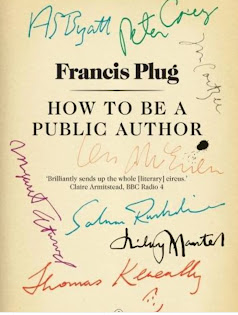
Paul Ewen is a New Zealand writer who lives in London. His character Francis Plug manages to be both witless and funny at the same time, in the manner of Flight of the Conchords taking on New York with their folk-rock (in this case, Plug is an English gardener and would-be novelist). The Australian Text Publishing edition includes the summation that the book is ‘an affectionate satire on the world of literature’. It is comic, and many of the misadventures are of the more genteel kind, but I am not sure that the satire can be described as ‘affectionate’. In fact, what I liked best about Francis Plug’s How to be a Public Author was the juxtaposition of Plug’s generous eccentricity (albeit in an alcoholic haze) and the intolerance, indifference and meanness of both the middle-class audiences of literary events, and their self-satisfied authors. There are a few exceptions in Plug’s recollections of his visits to book readings, but Ruth Rendell’s “SHOO! SHOO!” (178) cuts to the chase. ...
Infatuations

Image
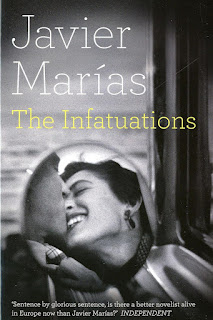
It is a painfully smug habit to begin a review by referring to other books you have read by the same author. In my case these are All Souls (1989); A Heart so White (1992) and Dark Back of Time (1998). All Souls involves a Spanish academic and an affair, and is – according to Penguin Books – ‘a masterpiece of black humour’. A Heart so White involves an investigation into the past of the narrator’s father, with echoes of Macbeth. A Dark Back in Time is so strange that it is it attracts reviews with words like ‘extraordinary’ and ‘dazzling’ – a sure sign that no one can make head nor tail of what Javier Marías had in mind when he wrote a book with a character named Javier Marías recalling the sources of his earlier writing. The Infatuations , I am relieved to say keeps its digressions and literary allusions under tight discipline, paradoxically through sentences that can only be described as ‘extraordinary’ and ‘dazzling’. This novel is difficult to describe without giving away ...

4321

Image
I have 13 Paul Auster novels on my bookshelves (14 if you include The Red Notebook ) and each one of them has been duly read and loved – with degrees of love, admittedly, but always love. I bought 4321 when it was released but baulked at it until December 2018. When you read the first of its 866 pages, you can understand that a commitment of time is needed. Not only that, but because the story is really 3 alternatives to 1 story (or 4 closely related, alternate stories) there is no use reading a few pages each day because you will just get lost. In the end, with other duties to attend to, I started in the holiday period and set myself the goal of getting through 50-60 pages a day, and that is an approach I can recommend for this weighty tome. Before starting the novel, I had understood the narrative strategy of providing the reader with different pathways for the main character, Archie Ferguson. However, it took me a few chapters to work out what was going on. Chapter “1.0” acts as...

Clive James -- Unreliable Memoirs

Image
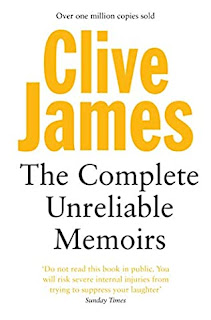
Clive James has in recent years been serialising his struggles with leukaemia in a series he calls ‘Reports of My Death’, which such headlines as ‘My new wheelchair is a thing of beauty and precision’. This is Clive James to a T: beautiful phrasing, unending humour, and the temerity to put himself at the centre of every phase of his life, and assume that interest will follow. It does, because his sentences are that good. The Preface of Unreliable Memoirs , for example, opens with this beautifully balanced pair: ‘Most first novels are disguised autobiographies. This autobiography is a disguised novel’ (1). The first chapter, ‘The Kid from Kogarah’ introduces the voice of the main character in this novel, the egotistical man writing the memoir: ‘I was born in 1939. The other big event of that year was the outbreak of the Second World War, but for the moment that did not affect me’ (3). What follows in this first book of James’ memoirs (there were three initially, and two more in r...

First Person

Image
All of Richard Flanagan’s novels are different. Death of a River Guide takes a tour through a drowning man’s Tasmanian family history; Gould’s Book of Fish is Flanagan’s masterpiece – a historical tale of a convict forger and fantasist. Then there was Wanting set in Dickens’ London and Bass Strait; the just-ahead-of-its-time tale of political manipulation in the age of terrorism – TheUnknown Terrorist ; and finally a well-deserved Booker winner, T he Narrow Road to the Deep North where torture on the Thai-Burma death railway is set against the present life of Dorrigo Evans. The earlier novels are more obviously ‘literary’ (I haven't read The Sound of One Hand Clapping but its description sounds poetic).  Flanagan seems adept at a more popular mode in Terrorist and Deep North (or, at least, a more straightforward one). If  Carey is Australian progressive rock; and Winton is Australian folk; then Richard Flanagan is  a one-man Supergroup, comfortable enough in ...

A Long Way from Home

Image
Many years ago, when I was a mere intellectual slip of a thing, I wrote an Honours thesis on Peter Carey’s two major novels at the time: Illywhacker (1985) and Oscar and Lucinda (1988). Given that and the fact that I have read all thirteen of Carey’s novels, writing about A Long Way from Home (2017) should be – one would think – a walk in the park. However, I have avoided this task. Perhaps I know too much, or ought to? In such circumstances, one fears to open one’s mouth. The way to overcome this is to write the first thing that comes to mind and avoid mentioning your hesitancy. Or use a Carey technique and write in two voices to construct a complex, ironic view of the subject at hand. The first voice is Irene Bobs, married to Titch, loyal to her husband despite – or perhaps because of -- the localized version of glamour and celebrity he represents. Titch is a Ford salesman, and the son of a once-famous aviator, ‘Dangerous Dan’, who is a bully and a shit-stirrer. Irene is a talen...

Keep the Aspidistra Flying

Image
George Orwell wrote six novels and three non-fiction books. Of the non-fiction, I have now read Down and Out in Paris and London (1933), and Homage to Catalonia (1938). “Down and Out” is – as it sounds – a portrait of poverty; and “Homage” the story of a man who sees a hopeful revolution collapse in the middle of a brutal civil war. Of the six novels, I have now managed (unsurprisingly) Animal Farm (1945), Nineteen Eighty-Four (1949) and Keep the Aspidistra Flying (1936). Listing these novels and books is only to say the following: I have read a bit of Orwell now, and amid the cleverness and the humanity and the bleakness of view, “Aspidistra” deserves a special mention (or perhaps, a vase) for being particularly depressing. The story is of a young man, twenty-nine as the story who has declared war against money (surely better than war against terror). In doing so, Gordon Comstock resists generations of middle class Comstock’s, who have done their duty and lived staid, stale ...