Posts

The Living Sea of Waking Dreams

Image
Serious writers have a way of getting under your skin, and like Don Delillo’s Zero K,   this novel takes a hard look at the way things are and doesn’t let the reader off the hook for a moment. If the satirical fable of Zero K centres on sleep as the answer to the woes of the world, Flanagan makes disappearance – of species, of body, of meaning – the heart of his message.   The Living Sea of Waking Dreams has a simple plot, one immediately relatable: three adult siblings gather around their dying mother and struggle to let her go. The protagonist, Anna, should hold the sensible middle ground once treatments to prolong Francie’s life become inhumane, but she is under the spell of the Terzo, a wealth manager who believes that money and influence can buy life. Anna’s other brother, Tommy, is a sympathetically drawn character -- a struggling artist, stuttering and sentimental. A dead fourth sibling casts a dark shadow: Ronnie, a teenage suicide, likely the result of his interac...
Zero K

Image
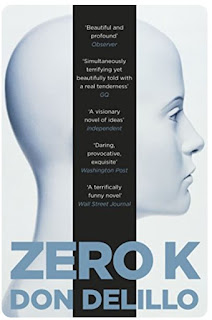
Some of my students bought me this book, knowing that I am a fan of Don Delillo, having heard me talk about End Zone and White Noise (see earlier reviews). Like these earlier novels, Zero K is set in end-times for the human race (while the race continues on as ever). Not nuclear catastrophe, however, but an overreliance on technology, growing autocracy, and climate change as background. The immediate story is how to escape via a fairly extreme version of the underground bunker. By choosing the time of their suspension via cryogenics, the ultra-rich hope to weather the storm of the coming apocalypse and wake to a better world. This all seems  like madness to the storyteller, Jeffrey, whose step-mother Artis and billionaire father Ross Lockhart seek to take this bizarre leap of faith (involving, as it does, the preservation of the body and brain as separate commodities). The first line of the novel sets the theme in motion: “Everybody wants to own the end of the world” (p.3). ...

The Dickens Boy

Image
  Tom Keneally is a most prolific writer, with 34 published novels, 15 works of significant non-fiction, and two children’s collections. Almost Dickensian in output. His 1982 Booker-prize winning Schindler's Ark is his most famous book internationally and the basis of the film Schindler's List (1993) directed by Stephen Spielberg. Keneally, now aged 86, has had a long career and knows a thing or two about writing. The Dickens Boy is a richly imagined novel about the real-life journey to Australia by Edward Bulwer Lytton Dickens, known to everyone as Plorn, Dicken’s tenth child. Plorn is a likeable young Englishman, only sixteen when the story begins. His first stay in Australia is at a station named Eli Elwah, and he only lasts 12 hours. Young Dickens is angered by the station manager’s rude inquiries and innuendo about his father’s personal life, and goes so far as to threaten a ‘trial of honour’ to which the station manager replies, ‘Can you believe this bloke? (p.17). Stir...

Quichotte

Image
The premise of this novel appeals to fans of metafiction and Salman Rushdie. A spy thriller writer, Sam DuChamp, turns his attention to a more literary story—a picaresque novel about Ismail Smile — a traveling salesman of pharmaceutical products. Smile falls in love with a TV-host star, and travels across America on quest to win her love. Meanwhile, Smile conjures up a son, Sancho, who begins to have a life of his own, slowly moving from the imaginary world to the world of flesh and blood.  Like a 19th century novel, each chapter begins with a helpful summary as subtitle (e.g. Chapter One: Quichotte, an old man, falls in love, embarks on a quest & becomes a father). Chapter Two introduces the author of the character Quichotte – Sam DuChamp, and so the layering of the fictional world begins. So far, so good. When introducing DuChamp, however, the narrator highlights DuChamp’s fictional status (“we will call him Brother” p.21). Then there is the unsettling instability of the text...

Mr Wilder and Me

Image
Jonathon Coe and this reader share many passions, though Coe drips success, and I mostly just drip. Here’s Coe: MA, PhD in literature; musician before a writer; fan of progressive rock; the Duke of Prunes in Javier Marías’s kingdom of Redonda . Mr Wilder and Me is his latest work, and the first Coe novel I have read. Good gifts are like that: just outside your reading preferences but connected to your interests in one way or another. Here we have a young adventurer (Calista) and a real-life film legend, Billy Wilder. There is a Greek island and sharp conversations and gleaned insights into the mind of an aging artist and his urgent need to create, even when the times have changed and success of films like Sunset Boulevard and Double Indemnity is in the past. Coe bookends the novel in the near-present with Calista in London, ‘almost sixty’, about to drive one of her daughters to Heathrow (she’s headed to Australia, a crisis point in many an English household and story). Calista has ...

The Midnight Library

Image
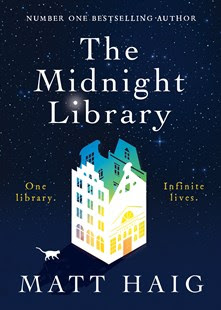
The Midnight Library is Borges-Lite. Think ‘The Library of Babel’ as a novel for twenty-somethings. A confused young woman – attempting suicide – ends up in a library as a half-way house between here and there. On the shelves are an infinite number of variations of the life she has to this point led, and she has a chance to try them all. Until the shoe fits. (The shoe, however, gets tighter and death – real death – is a distinct possibility). Nora Seed has gone to seed – she has walked away from a musical dream and let her brother down in the process; she lives alone after dumping her fiancé; she's a depressive employee of a music shop where moping puts off customers. There’s not much worth living for, she thinks. Once in the library (having taken the red pill or the blue pill, or both) she comes across the manifestation of the kind librarian who looked after her the day her mother died, while still at school. Kindness is returned in the temporary after life.  What would you ch...

The Labyrinth of the Spirits

Image
  The Labyrinth of the Spirits is the final instalment of a cycle known as "The Cemetery of Forgotten Books". Its predecessors include The Shadow of the Wind (2004), The Angel’s Game (2009) and The Prisoner of Heaven (2013). This equates to 2232 pages, and that means I have spent quite a few hours over the years in the esteemed company of the author Carlos Ruiz Zaf ó n, who sadly left us much too early this year, aged 55. The popularity of the series must buoy fans of literature in that the subject of the novels is literature itself, though the context is the dark period of the Spanish Civil War and its aftermath in Franco’s Spain. The melding of Letters and History produces a unique blend of genres, including mystery, crime, romance, thriller (and various subgenres, such as literary thriller and political thriller). In this, there is something for everyone – though this last instalment is over 800 pages – so one for those who like their books big, like a big Shiraz. ...