Posts

Their Brilliant Careers
Image
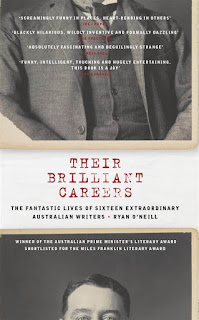
In her foreword to Ryan O’Neill’s Their Brilliant Careers, Anne Zoellner praises O’Neill’s ‘skill and empathy’ in rendering pen-portraits of ‘famous, infamous and forgotten’ Australian writers. We are used to sporting stars speaking of themselves in the third person, but rarely do they get to invent a critic speaking on their behalf.   The condensed lives O’Neill recalls in these sixteen ‘biographies’ of invented Australian writers follows various literary traditions, including Nabokov’s playfulness -- Shannon Burn's suggests Pale Fire (1962) in her Sydney Review of Books article. Personally I remembered John Clarke. I’ve read a few of Clarke's pastiche-poems at some point – his website certainly suggests that they once existed: ‘For many years it was assumed that poetry came from England. Research now clearly demonstrates, however, that a great many of the world’s most famous poets were Australian. This project puts on record the wealth of imagery in Australian...
Zorba the Greek

Image
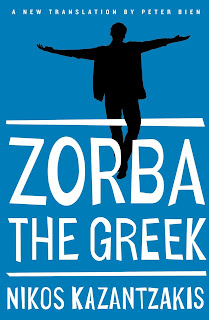
Nikos Kazantzakis’ Zorba the Greek is one of those famous books that is nothing like what you expect when you start to read it. That, at least, was my experience. Perhaps I had expected something purely comic: a Don Quixote of modern Greece. Since the novel does have a comic duo of sorts in the intellectual narrator (‘Boss') and his much more passionate sidekick (Alexis Zorba) setting out on an adventure, full of illusions – there may be something in that comparison. Another starting point might be to consider Zorba the Greek alongside The Great Gatsby – where the character under study by the narrator is a down-to-earth working- man, rather than a grand dreamer and great liar. Both novels have bookish narrators who admire another man’s zest for life. In both books, the narrator is searching for some meaning beyond the material concerns of his age. The new translation by Peter Bien opens with a prologue not included in the standard translation. The first line reads ‘I often...

Machines Like Me

Image
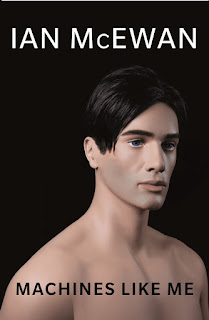
Ian McEwan writes about human dramas involving love and violence with force majeure, and Machines like Me does not let the McEwan reader down. Published in the year after the bicentennial of Mary Shelley’s Frankenstein , McEwan’s narrator, thirty-two year old Charlie – has a background in anthropology and an interest in electronics. His girlfriend, Miranda, is writing a PhD on the Corn Laws – a subtle connection to Shelley’s context. More directly, although not the inventor/creator of Adam, Charlie is his human God in that he and Miranda make choices about Adam’s personality, nurture the first stages of his life and slowly introduce him to the world. Like the Creature, Adam's consciousness comes in stages, while his conscience – if we can call it that—centres on relentless algorithms of truth. Then there are questions about monstrosity – the potential of the muscular Adam to break and arm and worse; the introduction of a rapist and the monsters of the age (war, the monstrosit...

The Paper Men

Image
The English writer William Golding – third in The Times 2008 list of ‘great British writers since 1945’ – needs no introduction, though I suspect that his 1984 novel The Paper Men might. The Paper Men was one of his late novels, published before the last two books from the trilogy To the Ends of the Earth (1987, 1989) and a posthumous novel, The Double Tongue (1995). Golding published 13 novels, though it is his first that everyone knows. Let me pass you the conch if you want to comment on any of Golding’s earlier works. I found The Paper Men in a second hand bookshop in Katoomba and read it on the recommendation of a university professor after he had read a chapter of my current creative work in progress. Frank Kermode, reviewing The Paper Men in 1984, described it as ‘a concerto for piccolo.’ I am not usually in the business of quoting reviewers, but this is Kermode, and I am still trying to figure out what to make of the principal character, the alcoholic genius writer, W...

Heart of the Grass Tree

Image
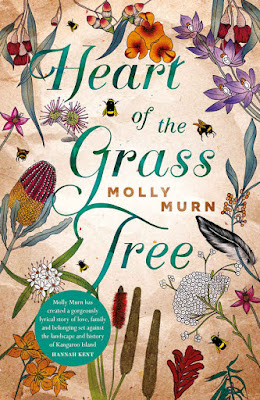
Molly Murn’s Heart of the Grass Tree (2018) is a complex story and one that reveals her courage and ambition. In writing this, I know that certain readers will remember Sir Humphrey Appleby’s particular use of the word ‘courageous’ in Yes Minister to suggest something brave but politically risky. Murn’s novel is courageous in the more profound sense that she takes the reader into the ‘heart of the grass tree’ – and that heart means confronting historical injustices for the indigenous Ngarrindjeri people. Murn obviously cares deeply about her subject matter; her approach demonstrates sensitivity, balancing scholarship with seeking permission from individual Ngarrindjeri people. This she outlines in the ‘Author’s Note’. The sensitivity is evident also in her narrative  structure. By including a contemporary story – a young woman grieving for her recently departed grandmother – the reader is introduced into the universal idea of ‘story’ and ‘place’ through the special memories...

White Noise

Image
It is hard to call yourself a Don Delillo fan when he has published 15+ novels and all you have read is Endzone (see earlier review), White Noise , and the short story collection The Angel Esmeralda . Still, I’m a fan. White Noise is a novel I’d heard about and perhaps wondered about for a long time. It was published in 1984, in the midst of the 1980s escalation of the Cold War and it has everything you would expect from a great novelist. A clever setup – Jack Gladney, lecturer in Hitler studies no less, is a man with a certain nervousness around his family and a insecurity complex coming in part from his lack of familiarity with the German language.  Then the catalyst for change: a chemical cloud, an ‘airborne toxic event’ which hovers gigantic nearby and causes the evacuation of the university town where Jack lives, like a radiation cloud gone astray from its nuclear referent. Around this event the novel circulates, crackles even, with brilliance, particularly in dialogue. ...

The Butcherbird Stories

Image
I very much enjoyed these Euro-Australian short stories, with an author A. S Patrić born in the former-Yugoslavia, and bringing to his fiction not only the ‘outsider’ perspective on Australian culture, but the alienation of Kafka, and something of the hard-edge of Raymond Carver. ‘Memories of Jane Doe’ could be a Carver story, or else Richard Ford – and yet sadly (thematically) also straight out of the Australian news. ‘Doe’ deals with the disappearance of a young European dreamer at the hands of a violent chef, with a wry and sad comment on a restaurant-owner who might turn a blind eye to preserve her business. ‘Among the Ruins’ sounds like Borges, but is the ‘backstory’ of one of the men who arrest Joseph K in Kafka’s The Trial , and here we are in European territory. This movement of sensibilities and styles intrigues me very much. In ‘The Flood’ a self-educated European-Australian taxi driver takes an older man for a drive in his taxi, with suitcases and an ‘outmoded code of...