Posts

The Noise of Time

Image
Shostakovich’ s life story as a composer behind the Iron Curtain is told here by Julian Barnes in the style of limited-omniscient third person narrative, combined with a narrator who intervenes indirectly but is always present. Writing about power is not new to Barnes – his 1992 novel Porcupine concerned a former dictator in a post-communist society. He has also written before about famous artists, most notably in Flaubert’s Parrot (1984). One might say he brings these two themes together here, with a sympathetic view of a composer whose work and political outlook are compromised by the era in which he lives; yet he strives to compose all the same, and to make use of such tools are irony to deal with the question of State approval under a totalitarian system. I’ve encouraged my students to read The Noise of Time because we are studying literature and film about (and written during) the Cold War era. Much of this is western in outlook; here an established western writer looks back...
Fiesta: The Sun Also Rises

Image
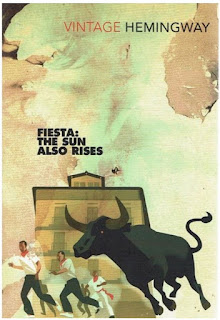
There must be something crippling in writing about Hemingway. The temptation would be write a review, and then cross everything out, and just have a sentence left (in tribute to the Iceberg theory etcetera). So, in keeping with this spirit, I will try to say very little about the book. Sticking to the facts – I am on my fourth Hemingway book over the last year or two, and in this order: A Moveable Feast, The Snows of Kilimanjaro, For Whom the Bell Tolls, Fiesta: The Sun Also Rises. I’ve enjoyed them all immensely. If I had to pick a favourite so far, it would be reading about Robert Jordan’s life in the hills during the Spanish Civil War. There, it seems to me, the writer-expatriate figure of the stories meets his match in the monumental events of the time. The first half of “Fiesta” takes us into the 1920s expatriate life of writers and their waiters (or waiters and their writers). The narrator, Jake Barnes, is part of the action but not as caught up in the rivalries as h...

Street to Street

Image
Brian Castro’s Street to Street felt like a novel meant for me to read. This might sound like a very egotistical thing to say, but what I mean is that I sense that I am well equipped – by virtue of my particular background and sympathies – to appreciate its virtues and I think its purposes. Castro is quite a busy author and I have read only a few of his books: Double-Wolf (1991), The Garden Book (2005), and The Bath Fugues (2009). He is a writer drawn to writing about artists and outsiders, and in Street to Street , he finds his subject in the dual narrative of that Sydney, belated Romantic poet Christopher Brennan, and a (beautifully) flawed academic and would-be Brennan biographer, Brendan Costa. In order to manage the ending, a more shadowy friend-of-Costa makes an occasional narrative appearance (and I think is a less successful voice than Costa). One of Castro’s principal sources for Brennan’s life is Axel Clark’s Christopher Brennan – A Critical Biography (1980). Some ye...

Down and Out in Paris and London

Image
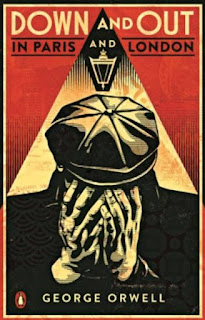
I read Orwell’s Homage to Catalonia in 2015 and was impressed by his depiction of Barcelona, and the intimate picture of his involvement in the POUM in the early days of the Spanish Civil War. I think I expected something similar of Down and Out in Paris and London , which is of course quite ridiculous, given not on the different cities but also the civilian life he sets out to describe. I suppose what I mean to say is that because Orwell has such a huge reputation for political insight (from later works) I had possibly expected more social commentary or critique of an intellectual kind. What Orwell does instead, of course, is to write a memoir in which he documents his experiences of poverty in Paris, and in London. In themselves, both depictions are devastating critiques, without the ‘argument’ (the experiences of poverty he describes largely speak for themselves). In Paris, Orwell – or his speaker in the case of that necessary separation between writer and actor, even in a memo...

The Course of Love

Image
Back in the 1990s, a fiction subgenre emerged in England parallel to the men’s magazines (or rather, lad’s magazines) which popularised views of a new version of masculinity, more hip, more ‘Cool Britannica’, fluid to a degree and yet ultimately re-presenting the experience of prolonged heterosexual adolescence. Alain de Botton’s three novels – Essays in Love, The Romantic Movement and Kiss and Tell were written at the high-brow end of this spectrum, integrating de Botton’s reading of philosophy, psychology and literature within an accessible romantic love story of the boy-meets-girl, move-in-together, break-up and learn-something-new variety. As a more genuinely accomplished novelist, Nick Hornby was more successful, with film versions of High Fidelity and About a Boy to boost the book sales. His stories were about flawed-yet-likeable males who needed to learn something, by means of the same romantic cycle. Another example was Mike Gayle’s novels, such as Mr Commitment and Turning...

What we talk about when we talk about love

Image
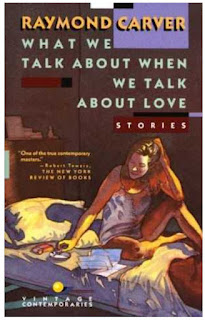
This is a very well known collection of perfectly written short stories by the American writer, Raymond Carver. They are best read with a glass of beer, or wine, or something stronger if you can keep your head. I am going to confess that this was my first Carver experience; I wouldn’t be original in saying that the economy of style reminds readers of Hemingway and that thematically the collection could also be placed alongside of Richard Ford’s short story writing ( Rock Springs ). So, we are talking about masculine prose, which manages to be both serious, sad, without "funny" irony, and yet also resonates in that human vein which American short story writers seem to manage better than anyone. A few examples of what’s in the collection – more for myself than for anyone who might be kind enough to read this blog. ‘Why Don’t You Dance?’ is the opening story, and it’s a story that speaks deeply through things that aren’t said (in that Hemingway notion of the omis...

Black Mirror

Image
Gail Jones’ 2002 novel Black Mirror holds my interest for a number of reasons. First, Professor Jones is one of the leading lights at the Western Sydney University’s Writing & Society Research Centre where I am currently enrolled in a doctoral program. Second, the novel explores modernism, and an Australian artist in Paris and London; and a young researcher who goes to see the elderly artist in search of some personal truths. When I read about the nature of the novel, I feared a little (as writers do) that my own thoughts and ideas may have already been captured by this prize-winning writer. However, Jones’ book is quite different to the one I hope to write, and having read it, I can breathe more easily. What follows is then just a few observations. The novel opens in the viewpoint of the young Anna Griffin, about to interview the famous surrealist, Victoria Morrell. The same rainy scene is then told from Victoria’s perspective; and so quite easily and naturally, the reader un...