Posts

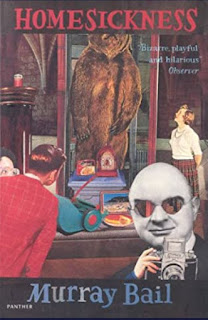
Homesickness

Image
I have come to this novel rather late, having read Eucalyptus when it was released in 1998 and, I must admit, nothing by Murray Bail since (re-reading Eucalyptus to teach doesn’t really count). Homesickness was published in 1980, and I have found a second-hand, first paperback edition from that era. His other books are Holden’s Performance (1987); The Pages (2008) and The Voyage (2012). For a writer like me who churns out a novel every ten years, Bail’s pauses between novels are almost encouraging.   My main reason for reading this novel was to see how it dealt with themes that might be said to connect with the expatriate experience. I read that Bail lived overseas at the end of the 1960s in India, and then in England and Europe from 1970 to 1974. Although Homesickness is a 1980 publication, it is most assuredly a 1970s book; one can almost taste the stale Qantas food and touch the (probably) too-proud wallpaper in Australia House in London, where two of the charact...

Big Blue Sky

Image
With the key theme of the environment, this autobiography/memoir suffered in comparison to the more literary 'Island Home' by Tim Winton I was reading at the same time. Leaving aside this rather unfair comparison, Garrett's story reignited my interest in Midnight Oil by giving me a better understanding of Garrett's continuous (rather than broken) passion for politics and debate. While he pulls no punches in his assessment of key Labor figures (describing Rudd as a 'threat to national security' p.424), Garrett shies away from any real detail about the most painful moments of his life, both personal and political. One senses that rare thing - a private man who writes a memoir. Like 'Oils' music, Garrett attempts to shine the light on the issues rather than himself, but he can't help setting the record straight at the same time - and the result is a rather awkward memoir which is a little personal, but at arm's length. This is for Garrett fans wh...

Island Home

Image
Tim Winton’s ‘landscape memoir’ indicates his central thesis: that the sense of place that is unique in Australia is what shapes him, and if we follow Winton’s logic, all of us (if only we would allow it). While the chapters are not completely sequential, he opens in County Offaly, Ireland, in 1988, and ends on Anzac Day (in what feels like a recent reflection). Most of the memoir is about Winton’s Australian life and the local landscape, though he does take us to Europe on occasion– where he feels that architecture cannot compensate for the lack of a wide sky since he ‘was calibrated differently to a European’ (p.14). For various personal reasons of my own travels, I really enjoyed the chapters that dealt directly with expatriate issues: ‘The Island Seen and Felt’, ‘Waychinicup, 1987’, and particularly the essay, ‘The Power of Place’. Winton has spoken on these matters before – that sense in which he is a writer on the wrong side of a continent on the wrong side of the hemispher...

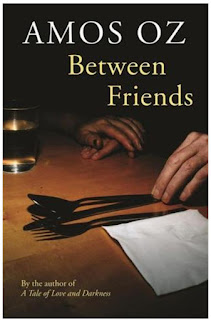
Between Friends

Image
I bought the hardback of Amos Oz's Between Friends (2012) this year from a good bookstore, on sale for $5. I felt a bit sad buying the book at this price, like a man taking pity on a stray dog at the pound of some undoubtedly good pedigree, misplaced. And that feeling of melancholy lasted with me as I read the book, the fourth I have read by the Israeli writer, peacemaker, and intellectual. This is a short book so I will tell a little of my other readings first. Black Box (1988) is written as a series of letters between divorcees with shared responsibility for their son, Boaz. Just having a character, Alec, as a university professor, travelling between locations as part of the correspondence introduces a political and social complexity. It’s an intellectual book about emotional issues; something that fills me with envy as a writer. In the Land of Oz (1983; 1993) is a memoir of voices of Israel and the West Bank from the 1980s – of both and all sides (if you can see that paradox...

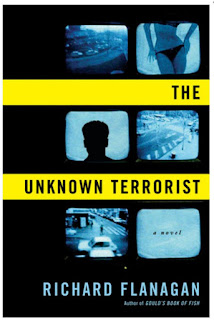
The Unknown Terrorist

Image
I am very intrigued by writers who seem to be able to shift gears so dramatically. Richard Flanagan’s The Unknown Terrorist is like a Stephen King novel, skilfully written as a genre piece, almost with the trace of the author’s style. If you are a fan of Flanagan’s earlier books, particularly Death of a River Guide and Gould’s Book of Fish, then you will scarcely recognise the prose. But form suits the message here. Flanagan is writing for a wider audience, and he wants to give them a very clear message: we construct our own monsters, from our own fears. This is a case of using a popular form of fiction to portray an unpopular idea; the irrational fears that beset us make us vulnerable to manipulation by government agencies bent on power, and media outlets bent on profit. I wondered whether the title, ‘The Unknown Terrorist’ is something of a play on W. H. Auden’s famous poem, ‘The Unknown Citizen’. Auden writes about a man who has done nothing wrong, and indeed, is a modern sa...

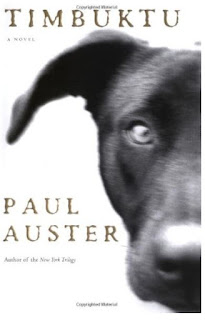
Timbuktu

Image
Paul Auster is one of my favourite authors, and so even when I don’t think one of his books is as good (read engaging, moving, strange ) as another, I find it hard to criticise. That’s okay – I am a reader rather than a professional reviewer, and I can just voice what I understood about the book and hint at some dissatisfaction, with sending the dog to the kennel without supper. The starting point is that this is a story about a man and a dog. At first, it is more about the man, a dysfunctional Brooklyn poet who has taken a Santa Claus vow to be helpful to others. We wonder - along with our narrator, Mr Bones – whether Willy G Christmas will survive long enough to meet his old teacher and mentor, Bea Swanson, and what it will mean if he does. There is some urgency here, since ‘the smell of death had settled upon Willy G Christmas, and as surely as the sun was a lamp in the clouds that went off and on every day, the end was drawing near’. I’m not sure about other readers, but I t...

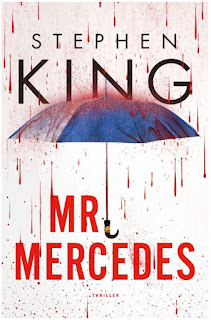
Mr Mercedes

Image
Strange to say that this is the first Stephen King book I have read, though I come to the table knowing about his brilliance as a plotter, and his authority as a writer, especially in terms of his open advice to would-be authors. This reputation also makes me nervous to be critical; there does appear to be a different set of rules for King and writers of his ilk. So, this will be a neutral review and confined to some simple observations. With regards to plot and structure, the novel concerns a mass-murderer/white terrorist; one without religious impulse (unless you count quoting from Nietzsche – when you gaze into the abyss, the abyss also gazes into you ). On this point, King makes the reader aware of the mass murderer’s reflections on 9/11 on two occasions; the first is the annoyance of someone who is aware of extra security and back-pack checks which restrict his own use of plastic explosives (“they spoiled it for the rest of us” p.252). The second time he ‘muses’ on the terrori...