Posts

The Snow Kimono

Image
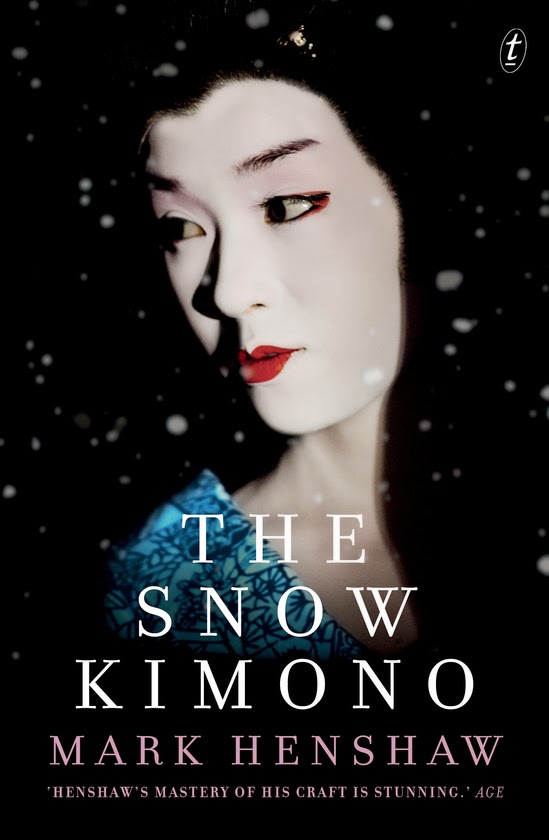
Mark Henshaw's The Snow Kimono begins in a deceptively straightforward manner with the introduction of Auguste Jovert, former police inspector, now retired Parisian. He meets a Japanese man of his age who introduces himself as Tadashi Omura, a former professor of law, now resident of the same apartment block as Jovert. Henshaw utitlises an omniscient narrative technique that allows him to move between storytellers with ease. For example, Omura's narrative, begins as such: 'One afternoon, Omura was saying, I decided to take Fumiko to see her mother's grave' (p.10). The next six or seven pages follow this line, and then we are reminded of Jovert's place as listener in the present: 'Jovert sat looking across at [Omura]' (p.17). So far, so good, as we learn of Omura's love for his adopted daughter (or the girl he has brought up as his own, from the age of three). Things get complicated from here, so that it is in many ways hard to distil; Omura tells...

Dark Back in Time

Image
I picked up Javier Marias's "false novel" A Dark Back in Time on the basis of my enjoyment of two earlier novels - All Souls (1992) and A Heart so White (1995). My memory of these two novels was sufficiently vague for me not to be warned off by a rather enigmatic back-cover description. Of All Souls , I could only recall a university novel in the loosest terms; A Heart so White had a more conventional plot and I enjoyed the bookish narrator, with his marital problems and his overshadowing father. A Dark Back in Time promises to play with narrative structures - the back cover refers to "a man named Javier Marias" and one gets the idea that the writer will be somehow writer, narrator and character in the text. Indeed, this is the case. Fundamentally, Dark Back explores the historical and personal material that inspired All Souls and in that sense deliberately inhabits that space that writers normally take trouble to avoid - that is, the 'shadowland...

Canada

Image
Canada is a long novel - 511 pages - but in some respects it's two shorter novels and a postscript. Part One could certainly have been a book in itself, though getting the fuller life perspective is obviously what Ford is after by moving the story forward into Canada from Great Falls, Montana, where the first section takes place, to what happens next and thereafter. To make this a little clearer: Part One - 15 year old Dell Parsons and his immediate family before his parents unexpectedly decide to rob a bank and ruin their lives. Part Two - the same year and the next few months, now in rural and abandoned Saskatchewan, Canada. Dell, on his own, and in bad company through the misguided from-jail-plans of his mother. Part Three - sixty year-old Dell Parson, seeking out his sister before her upcoming death, thinking about his life since the days of his youth. There's nothing in this plot summary that gives too much away, because Ford uses the narrative foretelling technique to ...

Parrot and Olivier in America

Image
Peter Carey has written some challenging novels over the years - novels that require perseverance on the part of the reader, even though reviewers continue to talk about their ability to 'dazzle'. This reader is an unabashed fan of Carey, and so it was very unusual for me not to push myself a little and finish the novel. Indeed, I was half way through and more-or-less gave up and the hardback sat on the shelf for perhaps two years; in December I reorganised my bookshelves to include a section (indeed, a bookshelf) of unfinished readings. Parrot and Oliver in America  emerged as one I definitely wanted to finish, and so, onto the second half! I don't know if it was the Christmas spirit, but I thoroughly enjoying my second attempt. Fearing I would get shipwrecked a second time, I picked up from where I left off, and although I was initially a bit confused about the characters (particularly Parrot) I was quickly engaged in their American travels. Some familiar themes emerged...

The Truth about the Harry Quebert Affair

Image
I purchased this novel with high hopes - the blurb sounded just my thing: a story about an author accused of murder, and a young writer and protégé who must assist his mentor in solving the crime through writing a novel of his own. A metafictional premise, in other words, with a picture from Edward Hopper on the front cover. I should have been more weary of the heavy bold title which obscures the Hopper painting; there is something emblematic in this in terms of the promise of the book. In reviewing a highly successful novel written by a young European writer one is very conscious of not sounding like a bitter-and-twisted would-be-but-can't-be bestseller author oneself, jealous of the twists and turns of another's life. Keeping this in mind, I will do my best to be fair on the novel and author and begin with what works well (perhaps this is where the grab quotes normally come from). The novel has been compared to Stief Larsson's The Girl with the Dragon Tattoo . Yes, it...

Alfred de Musset - Confession of a Child of the Century

Image
This novel was a gift, and not in the sense of unexpected pleasure or revelation. It was a birthday present from someone very close to me, and someone quite French. As such, I read it - at first with some interest - and then out of a sort of mix of duty and despair at ending up with another unfinished novel on my bookshelf. The opening is interesting - the context of wars and revolutionary ideals betrayed, an Emperor come and gone, and the sense of modernity and change (published in 1836) and an awareness of the Romantic movement in the arts gives it a contemporaneous feel. But soon it becomes what is its central theme - a story of the search for love of one betrayed by his mistress. It is like Confessions of an Opium Eater (1821) only less visionary, in every sense. Perhaps it is a French thing to enjoy stories of aristocratic debauchery, where hints of sexual feats must serve over detailed descriptions in the sense of good taste, but I found it all rather self-...

Ferenc Karinthy - Metropole

Image
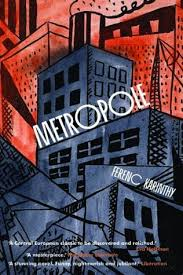
Karinthy's Metropole was given to me in France over Christmas by my brother-in-law; it appears to have been published in French in 1999 by Editions DENOEL and in English in 2008 by Telegram (UK). is a Kafka-like novel. I had never heard of the novel or the author, but now understand that he was from Hungary, and according to the back cover, was a novelist, playwright, journalist and water polo champion. Busy people, these Hungarians! As others have noted, it is a Kafkaesque tale, built on a simple premise (like The Trial , where Joseph K is under arrest but doesn't know why). In this case, the protagonist Budai is on a trip to Helsinki to attend a linguists' conference but someone ends up on the wrong plane, and subsequently, in an unknown, multicultural city, somewhere in the Northern Hemisphere (he eventually establishes, from the stars) but really - God-knows-where. Budai's incomprehension at his fate bears some similarity to Joseph K; it's a matter of a Eu...